
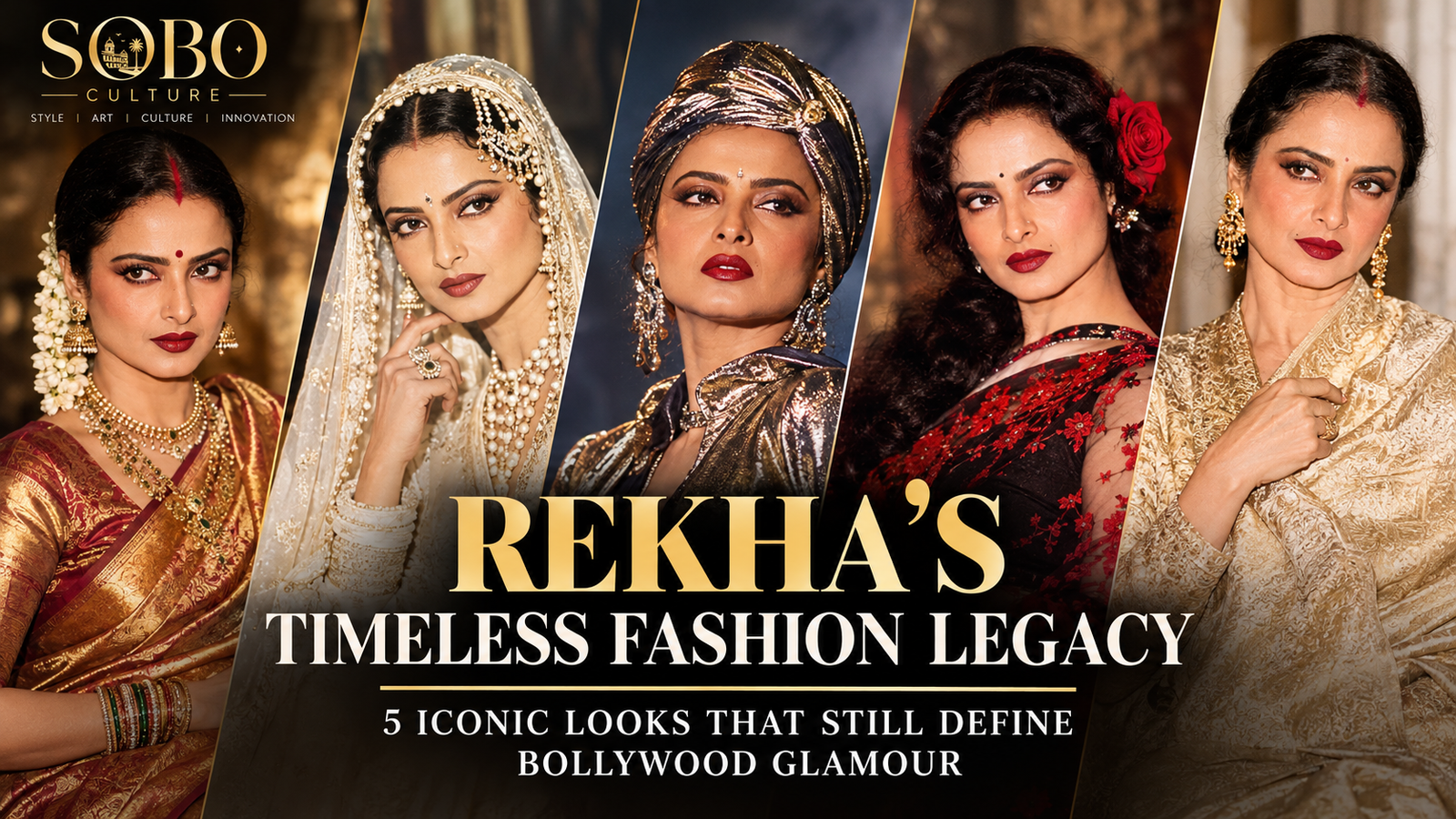
Actress Rekha's Fashion: From regal Kanjeevaram silks and the old-world elegance of Umrao Jaan to the fearless glamour of Khoon Bhari Maang, Rekha has built a fashion identity that transcends generations. In an industry where trends change overnight, the legendary actor continues to demonstrate that true style is not about reinvention alone—it is about creating a signature that belongs to you.


There are film stars who follow fashion, celebrities who help popularise trends, and a rare few who create a visual identity so distinctive that even a glimpse of their silhouette is enough to bring their name to mind. Rekha belongs firmly in the last category.
Across more than five decades in Indian cinema, Rekha has developed a style vocabulary that is unmistakably her own. The rich sheen of silk, elaborate gold jewellery, carefully arranged hair, expressive eyes and a striking lip colour have become recurring elements of her public image. Yet reducing her fashion legacy to sarees alone would overlook the remarkable range of her sartorial journey.
She has moved between the delicate, period-inspired costumes of Umrao Jaan (1981), the dramatic Western-influenced glamour of Khoon Bhari Maang (1988), and the richly layered traditional ensembles that have become her signature at public appearances. Each phase reveals a performer who understands that clothing can communicate character, confidence, cultural memory and personality.
What makes Rekha particularly fascinating is the consistency of her personal style. While contemporary celebrity fashion often revolves around constant transformation, her most recognisable looks return to a familiar aesthetic without feeling entirely repetitive. The colours change, the textiles evolve, and the accessories vary, but the overall sense of drama remains.
Her fashion legacy is not simply about wearing expensive-looking clothes or embracing maximalism. It is about the art of bringing multiple elements together so successfully that the complete look becomes more memorable than any individual garment.
And that is why comparing her with the industry's newest fashion sensations can miss the point. Rekha is not merely competing with a trend cycle. She has spent decades building an identity that exists beyond it.
1. The Kanjeevaram Saree: The Signature That Became Synonymous With Rekha


STYLE CATEGORY: Traditional Indian luxury · Heritage silk · Signature glamour
If one look has come to define Rekha's fashion identity, it is undoubtedly the richly coloured silk saree, particularly the Kanjeevaram. Over the years, the actor has made heritage Indian textiles an integral part of her public image, demonstrating how traditional clothing can feel glamorous, contemporary and deeply personal at the same time.
The Kanjeevaram saree, traditionally associated with Kanchipuram in Tamil Nadu, is celebrated for its lustrous silk, elaborate zari work and distinctive borders. Its visual richness makes it especially suited to ceremonial dressing, but Rekha's interpretation goes beyond simply choosing an opulent garment. She builds an entire look around the saree.
Her public appearances have included combinations of mauve and gold, turquoise and gold, and other vivid colour pairings. Broad borders, metallic detailing and contrasting shades give these ensembles their unmistakable presence. Rather than relying on a minimalist approach, she embraces the texture and visual depth of the fabric.
Breaking down the look
-
The saree: Rich silk with a noticeable sheen, often featuring zari borders, brocade details or contrasting colours. The fabric itself supplies much of the drama.
-
The blouse: Frequently a coordinating blouse with short or full sleeves, selected to complement the saree rather than compete with it.
-
The jewellery: Gold necklaces, kundan-inspired pieces, jhumkas, bangles and statement rings add layers of traditional ornamentation.
-
The hair: A centre-parted, neatly arranged bun, often adorned with gajra, creates a recognisable finishing touch.
-
The makeup: Defined eyes, luminous-looking skin and a strong lip colour reinforce the old-school Bollywood glamour associated with her appearances.
-
The finishing accessories: A traditional potli bag and carefully selected footwear complete the ensemble.
This combination was evident in her mauve-and-gold Kanjeevaram look at the Dior Fall 2023 show in Mumbai, where the saree was accompanied by traditional jewellery, a gold-toned potli and a gajra-adorned bun.
Why this look remains relevant
Rekha's approach shows that a heritage garment does not need to be stripped of its traditional character to feel fashionable. The silk, zari, jewellery and flowers work together because they belong to a coherent visual language.
The lesson for modern fashion is not to copy every accessory. It is to understand the importance of proportion, colour coordination and a recognisable finishing detail. A saree with a strong border can be the centrepiece of an outfit, while accessories reinforce its character.
Most importantly, Rekha wears the Kanjeevaram as a signature rather than a temporary trend. That consistency has helped turn a traditional textile into one of the most recognisable elements of her celebrity image.
2. Umrao Jaan: Ivory Anarkalis and the Poetry of Old-World Elegance


STYLE CATEGORY: Period couture · Mughal-inspired elegance · Understated opulence
Few cinematic fashion moments are as closely associated with Rekha as her portrayal of Umrao Jaan in Muzaffar Ali's 1981 film. The film's costume language draws on the refined, courtly world of the nineteenth-century courtesan, using delicate fabrics, intricate embellishment and traditional jewellery to create an atmosphere of restrained luxury.
Unlike the vivid silk sarees that define her later public appearances, the visual appeal of Umrao Jaan lies in softer colours and layered textures. Ivory and other muted tones, flowing anarkali-style silhouettes, delicate embroidery and pearls create an aesthetic that feels intimate and theatrical at once.
The clothes do more than establish a historical setting. They help communicate the character's refinement, artistic identity and emotional complexity. Vogue India has highlighted the film's ivory ensembles, lustrous fabrics and shimmering pearls as key elements of Rekha's memorable onscreen fashion.
Breaking down the look
-
The silhouette: Long, flowing anarkali-style outfits that create movement and graceful lines.
-
The colour palette: Ivory, cream and muted shades that bring softness to the overall appearance.
-
The fabric and embellishment: Lustrous textiles, delicate embroidery and decorative detailing that provide richness without depending entirely on bright colours.
-
The jewellery: Pearls and traditional ornaments reinforce the period-inspired aesthetic.
-
The beauty styling: Kohl-defined eyes and carefully arranged hair complete the character's old-world appearance.
-
The overall effect: Elegance through layering, craftsmanship and subtle visual detail rather than contemporary red-carpet spectacle.
Why this look remains relevant
The enduring appeal of Umrao Jaan lies in its restraint. Although the costumes are richly detailed, their elegance comes from the relationship between the silhouette, fabric, jewellery and character.
Modern festive fashion can draw inspiration from this approach through ivory anarkalis, embroidered dupattas, pearl jewellery and muted metallic accents. The objective is not to recreate a historical costume, but to preserve its sense of refinement.
The film also illustrates an important aspect of Rekha's legacy: her fashion identity was never limited to one silhouette. She could embody delicacy and poetic elegance on screen while embracing more dramatic glamour elsewhere.
Her portrayal of Umrao Jaan earned her the National Film Award for Best Actress, further cementing the film's place in her career.
3. Khoon Bhari Maang: The Fearless Power of 1980s Glamour


STYLE CATEGORY: Power dressing · Metallic glamour · Dramatic transformation
If Umrao Jaan represents the poetic side of Rekha's fashion legacy, Khoon Bhari Maang (1988) reveals its bolder, more experimental dimension.
The revenge drama follows Aarti, played by Rekha, whose transformation becomes central to the film's narrative. As the character's circumstances change, so does her wardrobe. The resulting looks move away from conventional, understated femininity and towards confident silhouettes, statement-making fabrics and high-impact accessories.
Vogue India's retrospective on the film identifies its bold monotones, metallic lamé, diamanté embellishment and dramatic headwear as defining elements of its visual style. The costumes reflect the film's larger transformation narrative, making fashion part of the storytelling rather than simply decoration.
Breaking down the look
-
The clothing: Western-influenced silhouettes and striking outfits that distinguish the transformed Aarti from her earlier appearance.
-
The colour story: Bold, often high-contrast shades and metallic finishes that command attention.
-
The embellishment: Sparkling details and diamanté-inspired accents that amplify the theatrical glamour.
-
The headwear: Dramatic wraps and metallic headpieces that give the looks a distinctive, almost editorial quality.
-
The makeup: Strong eye definition and polished beauty styling complement the assertive wardrobe.
-
The overall effect: A carefully constructed image of confidence, drama and reinvention.
The film's fashion also connects to Rekha's wider interest in statement headwear, which appeared in other roles, including Sheshnaag (1990) and Madam X (1994).
Why this look remains relevant
Today's fashion conversations often celebrate the idea of a dramatic makeover, but Khoon Bhari Maang explored that visual language decades earlier. Its wardrobe demonstrates how a change in silhouette, texture, accessories and styling can communicate a shift in a character's identity.
For a contemporary interpretation, the strongest elements are metallic fabrics, structured eveningwear, statement accessories and confident use of a single colour family. They can be adapted for evening events or fashion editorials without reproducing the original costumes literally.
This chapter is essential to understanding Rekha because it challenges the idea that her fashion legacy rests solely on traditional Indian dressing. Her appeal comes partly from the contrast between these different aesthetics—and her ability to inhabit both with conviction.
4. Parineeta: The Red-and-Black Saree That Turned Traditional Glamour Into Evening Drama


STYLE CATEGORY: Cocktail saree · Retro glamour · Statement eveningwear
Rekha's performance in the song Kaisi Paheli Zindagani from Parineeta (2005) offers another compelling example of her ability to make a traditional Indian garment feel strikingly different.
Here, the familiar elegance of the saree takes on a more theatrical, evening-ready character. The red-and-black embroidered net saree, paired with an off-shoulder blouse, creates a silhouette that feels closer to vintage cocktail glamour than conventional festive dressing.
The look is further distinguished by net gloves, a rose hair accessory, dramatic eye makeup and a bold lip. These elements transform the saree from a conventional occasionwear choice into a complete performance look. Hindustan Times has highlighted this ensemble among Rekha's memorable fashion moments, while Vogue India has described the appearance as an example of her ability to embrace a more party-oriented aesthetic.
Breaking down the look
-
The saree: A red-and-black embroidered net drape that combines the traditional saree silhouette with the visual lightness of sheer fabric.
-
The blouse: An off-shoulder design that changes the proportions of the outfit and gives it a distinctly eveningwear-inspired character.
-
The gloves: Sheer, mesh-style gloves add a theatrical touch associated with vintage glamour.
-
The hair accessory: A rose detail introduces a romantic accent against the stronger red-and-black palette.
-
The makeup: Defined eyes and a bold red lip provide a dramatic focal point.
-
The styling philosophy: Every detail contributes to the same glamorous mood, rather than competing for attention.
Why this look remains relevant
The Parineeta ensemble demonstrates how traditional clothing can be reinterpreted for a contemporary evening event. A saree does not always need to be styled with a conventional blouse, traditional jewellery and a fully heritage-inspired beauty look.
A sheer drape, an unconventional blouse or a distinctive accessory can create a different mood while preserving the garment's essential identity.
The most interesting feature is the balance between familiarity and experimentation. The saree remains recognisably Indian, but its styling introduces a theatrical quality that makes it memorable.
For fashion magazines, this is a particularly useful reference point: Rekha's style can be traditional without being predictable, and glamorous without following the usual rules of red-carpet dressing.
5. The Modern Rekha: The Art of Wearing Heritage With Contemporary Confidence


STYLE CATEGORY: Contemporary heritage · Couture-inspired draping · Modern Indian elegance
One of the most interesting aspects of Rekha's fashion evolution is that she has continued to experiment even after establishing her signature look. Her public appearances demonstrate that a strong personal style does not require wearing the same outfit repeatedly. Instead, familiar elements can be reinterpreted through different silhouettes, fabrics and styling choices.
Two particularly interesting examples are her contemporary saree-pant ensembles and her unconventional decision to wear a saree over a full-length kurta.
Look A: The saree-pant ensemble
Rekha has worn ivory and gold saree-pant combinations that introduce a contemporary construction to traditional Indian occasionwear. In the looks documented by Hindustan Times, embroidered or brocade sarees are paired with matching trousers, coordinating blouses and embellished footwear. Potli bags, jewellery and bold lip colour preserve the recognisable Rekha aesthetic.
The appeal lies in the contrast between the familiar saree and the more structured silhouette underneath it.
-
The drape: An ivory or gold-toned saree with embroidery, brocade or gota patti detailing.
-
The lower silhouette: Coordinating trousers that offer a contemporary alternative to a conventional underskirt.
-
The blouse: A matching design, sometimes with full sleeves, that maintains the richness of the overall ensemble.
-
The accessories: Traditional jewellery, an embellished potli and statement footwear connect the look to Rekha's established style.
-
The beauty: A bold lip and neatly arranged hair retain her familiar glamour.
This approach offers a lesson in modern occasionwear: innovation can come from changing the construction of a garment rather than abandoning traditional textiles altogether.
Look B: The saree worn over a full-length kurta
At the 2019 screening of Photograph, Rekha demonstrated another unexpected way to style a saree. Instead of wearing it with a conventional blouse, she draped an earthy-toned saree over an ivory silk kurta.
The ensemble was complemented by gold earrings and bangles, an ivory potli bag, gold heels and a bold red lip. The kurta's embroidered details introduced texture, while the comparatively understated saree allowed the overall combination to remain balanced.
The styling is noteworthy because it takes two familiar Indian wardrobe staples and combines them in an unconventional way.
-
The base layer: An ivory silk kurta with a longer silhouette.
-
The drape: An earthy, relatively unembellished saree that complements the kurta.
-
The accessories: Gold-toned jewellery, a potli bag and matching footwear bring continuity to the look.
-
The makeup: A strong lip colour provides contrast against the softer colour palette.
This is a more understated side of Rekha's style, but it reveals the same attention to detail seen in her grander appearances.
Why this look remains relevant
Rekha's contemporary ensembles show that heritage fashion is not frozen in time. Traditional Indian textiles can work with trousers, alternative layering, unexpected colour combinations and unconventional silhouettes.
Her approach is particularly relevant to designers exploring modern Indian occasionwear. The most effective reinterpretations do not discard tradition; they use it as a starting point for experimentation.
What Makes Rekha's Fashion Legacy So Difficult to Replicate?

Rekha's style is often described through individual elements: silk sarees, gold jewellery, a gajra-adorned bun and a red lip. But these details alone do not fully explain why her fashion identity remains so recognisable.
The larger story is about consistency, personal expression and the relationship between clothing and character.
1. She has built a recognisable visual identity
Many celebrities change their public appearance with every new trend. Rekha's approach has been different. She has repeatedly returned to familiar silhouettes, traditional textiles and signature beauty details, allowing these elements to become closely associated with her public image.
The Indian Express has highlighted the continuity of her style, particularly the recurring combination of a silk saree, gajra and sindoor.
2. She understands the power of maximalism
Rekha rarely treats an outfit as an isolated garment. Her most recognisable ensembles bring together fabric, jewellery, hair, makeup and accessories.
Her maximalism works because the elements contribute to a shared aesthetic. Rich textiles are paired with equally expressive jewellery, while the beauty styling reinforces the overall mood. Vogue India's retrospective on her saree collection notes her affinity for vivid colour combinations, ornate borders, layered jewellery and traditional accessories.
3. She respects traditional craftsmanship
The continued prominence of Kanjeevaram and Banarasi-style silk in her wardrobe gives her fashion identity a connection to India's textile heritage.
These fabrics carry their own visual character through weaving, colour, texture and ornamentation. By returning to them over decades, Rekha has helped keep traditional Indian dressing visible in a celebrity landscape that frequently embraces international trends.
Her influence is not limited to a particular garment. It also lies in demonstrating how heritage textiles can remain central to glamorous dressing.
4. She has never been confined to one fashion category
From the ivory ensembles of Umrao Jaan to the bold metallics of Khoon Bhari Maang, Rekha's cinematic wardrobe demonstrates a remarkable range.
Her off-screen fashion is more closely associated with traditional Indian dressing, but her onscreen appearances reveal an actor comfortable with experimentation. This distinction matters: a signature style does not have to mean an unchanging wardrobe.
Instead, Rekha's legacy combines a consistent personal identity with the ability to adapt her appearance to different characters, occasions and moods.
5. She makes the entire look matter
A beautifully woven saree can be memorable, but the way it is draped, accessorised and styled determines the impression it creates.
Rekha's most recognisable appearances demonstrate the importance of these finishing details. Her hair, jewellery and makeup are not afterthoughts; they are integral parts of the overall image.
This is also why reproducing one of her looks requires more than choosing a similar saree. The styling must work as a complete composition.
Five Fashion Lessons to Take From Rekha

1. Invest in pieces with lasting character
Choose garments for their craftsmanship, texture and versatility rather than only for their immediate trend appeal. A well-made silk saree can be styled in different ways for years.

2. Learn the beauty of restraint
The Umrao Jaan aesthetic shows how soft colours, delicate embellishment and thoughtful layering can create an equally compelling alternative to high-impact glamour.
3. Experiment with confidence
Metallic fabrics, unconventional accessories and strong silhouettes can give traditional or Western-inspired dressing a distinctive identity.
4. Give traditional clothing a new context
A different blouse, a sheer overlay or an unexpected accessory can transform a familiar saree into eveningwear with a personality of its own.

5. Develop a signature without becoming repetitive
Find the colours, silhouettes and details that feel authentic to your personal style, then experiment with new combinations while retaining that identity.
The Final Word: Rekha's Style Is More Than a Fashion Statement
In the world of celebrity fashion, it is easy to confuse novelty with originality. A new silhouette, a viral outfit or a striking red-carpet appearance can dominate a news cycle, but lasting influence is built over a much longer period.
Rekha's fashion journey offers a different perspective. Her style has evolved from the cinematic elegance of Umrao Jaan to the dramatic transformation of Khoon Bhari Maang, the cocktail glamour of Parineeta and the richly layered silk sarees that define many of her public appearances.
Across these different expressions, one quality remains constant: a strong sense of identity.
She has embraced traditional Indian textiles without becoming confined to them, experimented with Western silhouettes without losing her individuality, and returned to familiar styling elements without making them feel irrelevant. Her legacy lies in that balance between continuity and reinvention.
It would be difficult to claim that no one in the industry can ever match her fashion sense; style is subjective, and Indian cinema has produced many influential dressers. But Rekha's particular combination of cinematic history, heritage-inspired dressing, dramatic glamour and enduring personal signatures is unmistakably distinctive.
Perhaps the greatest lesson from Rekha is that timeless style is not about being the best dressed in every room. It is about developing an identity so recognisable that, decades later, the fashion world still looks to you for inspiration.
For a generation discovering vintage Bollywood glamour and another that grew up watching her films, Rekha remains a reminder that trends may return, but a truly individual style never really goes out of fashion.
Editorial note: The five looks in this feature are an editorial selection of Rekha's most memorable and influential fashion moments, not a verified ranking of her personal five favourites. Look descriptions draw on published fashion retrospectives; individual garment details can vary between appearances and film scenes.
Leave a Comment