


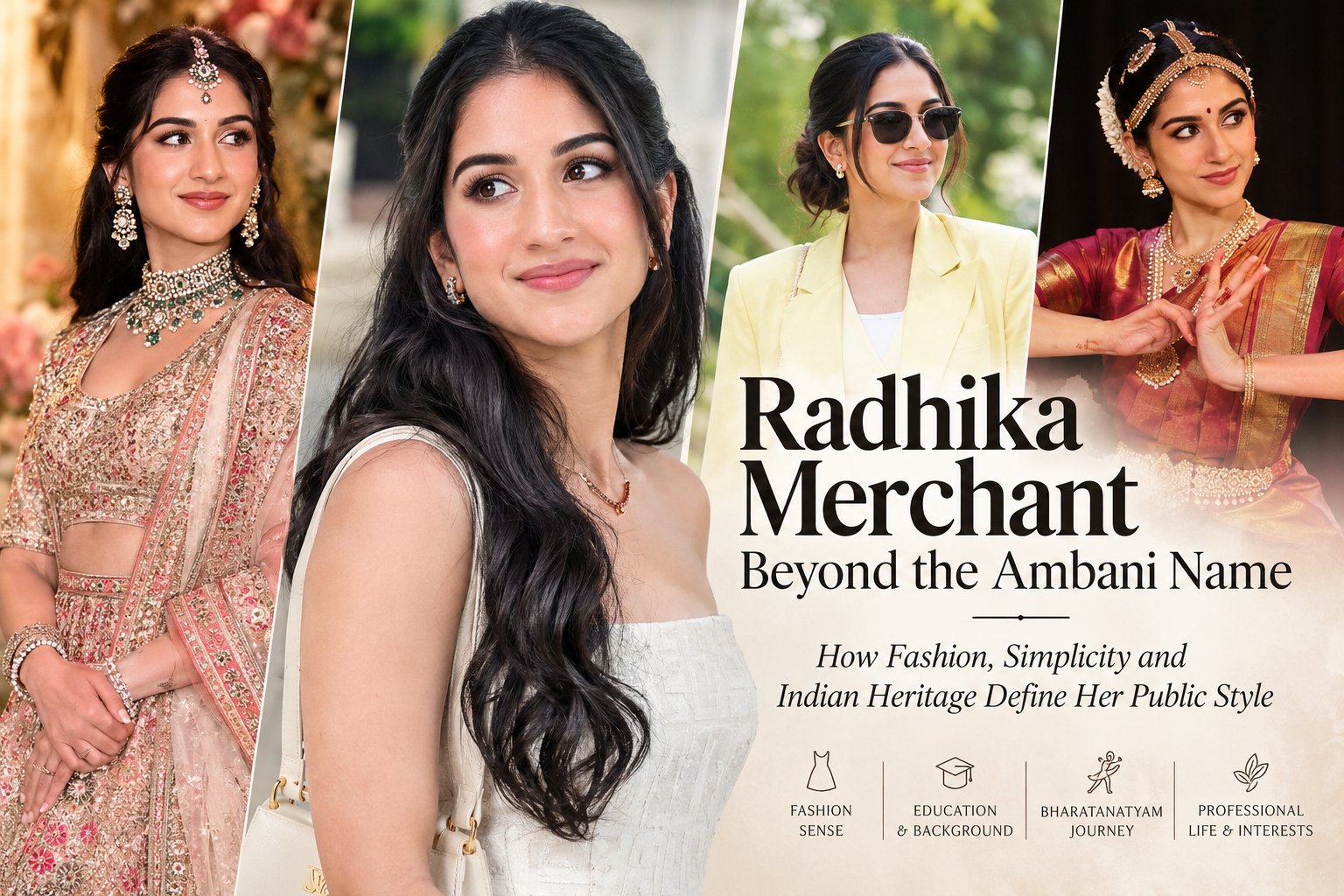

In a world where celebrity fashion is often measured by designer labels, extravagant jewellery and the price of an outfit, Radhika Merchant offers a more layered story. Her public appearances bring together Indian craftsmanship, contemporary couture, traditional values and moments of understated elegance. While her marriage to Anant Ambani has placed her among India's most closely watched public figures, her personal background and individual interests add important dimensions to her identity.
Why Radhika Merchant Is More Than an Ambani Bahu
Radhika became part of the Ambani family when she married Anant Ambani in July 2024. Since then, her fashion choices have attracted considerable attention, from intricately embroidered Indian ensembles to modern Western silhouettes and relaxed everyday outfits. Yet, what makes her style interesting is not simply the luxury associated with her wardrobe. It is the way she moves between different fashion languages without appearing confined to one particular aesthetic.
Her appeal lies in the contrast between grandeur and restraint. She can wear an elaborate couture creation for a major celebration and later appear in a relatively simple outfit with minimal accessories. This versatility has made her a subject of interest for fashion publications and observers who follow the evolving relationship between India's wealthy families, cultural identity and modern luxury.
Radhika Merchant's Background: Education, Family and Professional Life
Before she became widely recognised as Anant Ambani's wife, Radhika Merchant had her own educational and professional journey. She is the younger daughter of Viren Merchant, chief executive of Encore Healthcare, and Shaila Merchant, who has also been associated with the family business.
Radhika attended schools in Mumbai, including Cathedral and John Connon School and École Mondiale World School, before completing her International Baccalaureate diploma at BD Somani International School. She subsequently studied political science at New York University, graduating in 2017, according to published biographical accounts.
Her educational background is worth noting because it offers context beyond the fashion photographs that frequently circulate online. Studying political science provides exposure to institutions, public affairs and the ways societies function, although it would be inaccurate to assume that a degree alone explains her personal values or decisions.
Radhika has also been associated with the luxury real estate company Isprava before taking on responsibilities at Encore Healthcare, where she has served on the company's board. Her professional connections demonstrate that her public identity is not limited to fashion or social appearances.
For a fashion publication, this background matters because personal style does not develop in isolation. Education, professional environments, cultural exposure and individual interests can all influence how someone presents themselves. In Radhika's case, her public image combines the world of business with India's traditions and the international fashion scene.
Fashion Intelligence: Understanding the Difference Between Expensive and Expressive
One of the most interesting aspects of Radhika Merchant's wardrobe is its range. Her style moves between traditional Indian clothing, contemporary designer wear, archival fashion and more relaxed everyday dressing.
This versatility suggests an approach to fashion in which the occasion, silhouette, fabric, accessories and overall visual balance matter as much as the designer's name. It would be difficult to attribute every outfit to Radhika's personal choices alone, given the role professional stylists and designers play in high-profile appearances. Nevertheless, the finished looks offer plenty to examine from a fashion perspective.
A particularly striking example came during the 2024 pre-wedding celebrations, when Radhika wore a custom Versace gown for one of the events in Jamnagar. The look reflected the international couture dimension of her wardrobe. At the same time, her Indian ensembles throughout the celebrations highlighted the importance of embroidery, craftsmanship, jewellery and traditional silhouettes.
Her later appearances have continued to explore the relationship between contemporary design and heritage. In 2025, Vogue India highlighted her interpretation of a Vivienne Westwood-inspired look paired with a Chanderi sari. The combination brought together a recognisable Western design reference and an Indian textile tradition.
Such styling demonstrates why fashion can be more than a display of luxury. It can also be a conversation between different cultures, periods and design traditions.
The Power of Simplicity: When Less Becomes More
Radhika's simpler public appearances often provide a useful counterpoint to her elaborate ceremonial wardrobe.
In March 2025, The Indian Express covered her appearance in a white Self-Portrait midi dress, styled with a mangalsutra, a beige shoulder bag and understated makeup. The outfit was notable for its relatively restrained palette and everyday wearability, especially when compared with the elaborate ensembles associated with her wedding celebrations.
In June 2025, Hindustan Times reported on another appearance in Jamnagar, where she wore a pastel-yellow suit with flared trousers and a natural-looking beauty style. The outfit relied on soft colour, a straightforward silhouette and limited visual embellishment rather than elaborate ornamentation.
These looks illustrate an important principle of modern luxury: simplicity does not necessarily mean the absence of expensive clothing. It can mean allowing a garment's shape, colour, texture and styling to create the overall effect without overwhelming the wearer.
A white dress, a traditional suit or a well-chosen accessory can communicate a different kind of elegance from a heavily embellished lehenga. Neither approach is inherently superior. Their effectiveness depends on context, personal preference and how the individual combines the elements.
Radhika's wardrobe is particularly interesting because it accommodates both approaches. Her public style is not exclusively minimalist, nor is it limited to extravagant couture. Instead, it moves between them according to the occasion.
Traditional Indian Fashion: A Connection to Culture and Craftsmanship
Indian clothing has remained an important part of Radhika Merchant's public fashion identity. Her appearances in saris, lehengas and elaborately embroidered ensembles demonstrate how traditional garments can be adapted to contemporary tastes without losing their cultural character.
The appeal of these outfits often lies in the details: hand embroidery, intricate surface work, carefully constructed blouses, layered jewellery and the way a dupatta or sari is draped.
During the Ambani wedding celebrations, her bridal wardrobe attracted international attention. The scale of the celebrations provided a platform for Indian designers and traditional craftsmanship to reach a global audience, while Radhika's looks illustrated how heritage clothing can be interpreted through modern styling.
Traditional Indian fashion is not a single aesthetic. It encompasses regional textiles, different embroidery techniques, varied draping traditions and a wide range of silhouettes. When these elements are combined thoughtfully with contemporary design, the result can feel both rooted and current.
Radhika's wardrobe offers examples of this meeting point. Rather than treating Indian clothing and international couture as opposing choices, her public appearances suggest that both can coexist within one fashion identity.
The broader lesson for fashion enthusiasts is that cultural clothing need not be reserved for ceremonial occasions. Its techniques, textiles and design ideas can continue to influence everyday fashion, formalwear and contemporary couture.
Bharatanatyam: The Cultural Discipline Behind Her Public Image
Fashion is only one part of Radhika Merchant's background. She also trained in Bharatanatyam, one of India's classical dance traditions, for several years.
Her formal arangetram, marking an important milestone in a classical dancer's training, took place at Mumbai's Jio World Centre in June 2022. The performance brought attention to a practice that requires sustained training, musical understanding, rhythmic precision and familiarity with traditional storytelling.
Bharatanatyam is relevant to a discussion of her public image because it connects her to a cultural tradition that extends far beyond clothing. The dance form brings together movement, gesture, expression, music and carefully structured presentation.
It would be speculative to claim that her dance training directly determines her fashion choices. However, classical dance provides a meaningful context for understanding her engagement with Indian cultural traditions.
It also highlights a distinction between simply wearing traditional clothing and participating in the artistic practices that have shaped Indian cultural life. Her dance training represents a separate accomplishment that deserves recognition on its own terms.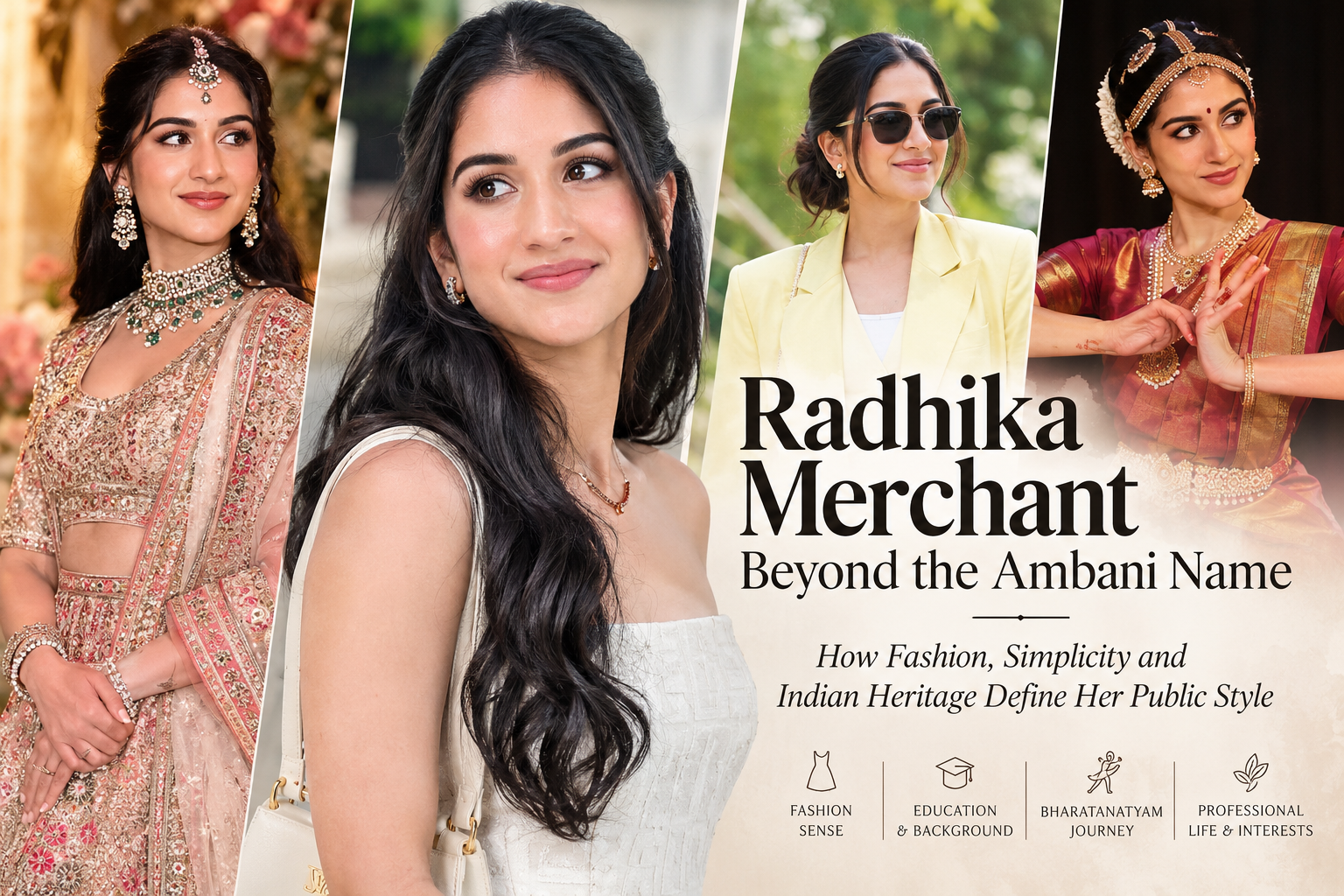
Her Approach to Media: A Public Image Built Through Selective Visibility
Radhika Merchant occupies an unusual position in contemporary Indian media. She is part of one of the country's most prominent business families, yet much of the public conversation around her centres on major family occasions, fashion appearances, cultural events and selected interviews.
This creates an interesting relationship between visibility and privacy.
The Ambani wedding celebrations generated enormous international attention, with coverage extending from Indian fashion publications to international lifestyle magazines. The scale of the events meant that clothing, jewellery, celebrity guests and visual presentation became major parts of the news cycle.
However, it would be inaccurate to conclude that Radhika personally controls every aspect of the resulting media coverage or deliberately follows a particular publicity strategy without direct evidence. Her public image is shaped by several factors, including family events, designers, stylists, photographers, editors and the wider media environment.
What can be observed is that her fashion appearances provide multiple dimensions for coverage. An elaborate bridal ensemble offers a story about craftsmanship and couture; a simple white dress creates an opportunity to discuss everyday elegance; and a traditional performance connects her to cultural heritage.
This range makes her interesting to fashion editors because her public appearances are not limited to one visual category.
Her media presence also raises a wider question about modern celebrity: must a person constantly share personal details to remain relevant? Radhika's public profile suggests that significant attention can arise from selected appearances and major events, even when there is limited publicly available information about everyday private life.
The distinction is important. A thoughtful fashion profile should analyse what is visible without inventing private motives or presenting assumptions about her personality as established facts.
Jewellery and Beauty: Knowing When to Let the Outfit Speak
Jewellery has a prominent place in many of Radhika Merchant's formal looks, particularly during wedding-related celebrations. Diamonds, traditional ornaments and statement necklaces have complemented the detailed clothing associated with these occasions.
Yet her simpler appearances show another approach: a small number of carefully selected accessories can give an outfit a recognisable finishing touch without competing with the clothing.
Her white-dress appearance in March 2025, for example, paired understated styling with a mangalsutra. The accessory carried personal and cultural significance while remaining compatible with the simplicity of the outfit.
Beauty styling follows a similar pattern across her different appearances. Elaborate events may call for more dramatic makeup, while daytime or casual appearances have featured softer, more natural-looking finishes.
The underlying fashion principle is balance. When clothing already includes intricate embroidery, substantial jewellery or a dramatic silhouette, restrained beauty styling can prevent the overall look from becoming visually crowded. With simpler clothing, accessories can introduce contrast and personality.
This is not a rule that every outfit must follow, but it is a useful way of understanding how individual styling decisions contribute to the finished appearance.
Beyond Fashion: Business, Animal Welfare and Personal Interests
Radhika Merchant's professional background and publicly reported interests add further context to her identity.
Her association with Encore Healthcare connects her to the business world, while published biographical accounts have also noted her interests in animal welfare, education and social causes.
She has been associated with the Ambani family's wider engagement with animal care through the public attention surrounding Vantara, the animal rescue and rehabilitation initiative connected to Jamnagar. The project has formed part of the wider narrative surrounding the family's activities, although individual responsibilities and contributions should not be assumed without specific evidence.
These interests matter to a fashion profile because public figures are often reduced to a handful of images or expensive outfits. A fuller account recognises that clothing is only one part of a person's public life.
It is equally important, however, to distinguish documented professional roles and reported interests from claims about private character. A balanced profile should acknowledge the available information without turning limited observations into sweeping conclusions about someone's values or personality.
Why Radhika Merchant's Style Resonates With Fashion Audiences
Radhika Merchant's appeal to fashion audiences rests on a combination of contrast, cultural references and the visibility of her public appearances.
First, her wardrobe crosses several categories. Traditional Indian couture, international designer fashion and relatively simple daytime clothing all feature in her public image.
Second, her outfits provide opportunities to examine the relationship between craftsmanship and modern styling. A sari paired with a contemporary design reference, for example, can open a conversation about how fashion traditions evolve.
Third, her public appearances illustrate the difference between ceremonial dressing and everyday presentation. A grand wedding outfit serves a different purpose from a business-casual ensemble or a simple midi dress. Comparing them without considering context would miss what makes each look distinctive.
Finally, her background adds depth to the discussion. Her education, professional associations and classical dance training provide a broader context than her marriage alone.
For fashion readers, the most useful takeaway is not that every outfit must be expensive or that simplicity is always preferable. It is that a wardrobe can accommodate different moods, settings and cultural influences while retaining a sense of continuity.
Conclusion: The Meaning of Elegance Beyond the Ambani Name
Radhika Merchant's position in the Ambani family has undoubtedly amplified public interest in her life and fashion choices. But reducing her style to her family connection would overlook the variety of her public wardrobe, her educational background, her professional associations and her training in Bharatanatyam.
Her fashion story is most compelling when viewed through the relationship between heritage and modernity. Elaborate Indian ensembles, international couture and understated everyday outfits each reveal a different side of contemporary luxury.
Her simpler appearances also offer a reminder that fashion does not have to rely on elaborate ornamentation to attract attention. Sometimes, a restrained colour palette, a well-chosen silhouette and a meaningful accessory can create an equally memorable look.
Ultimately, Radhika Merchant's public style is not defined by simplicity alone, nor by extravagance. It is defined by the range between the two. That range, combined with her cultural and professional background, makes her a relevant subject for a deeper fashion feature—one that looks beyond the Ambani surname to examine the choices, traditions and design conversations that shape her public image.
Leave a Comment